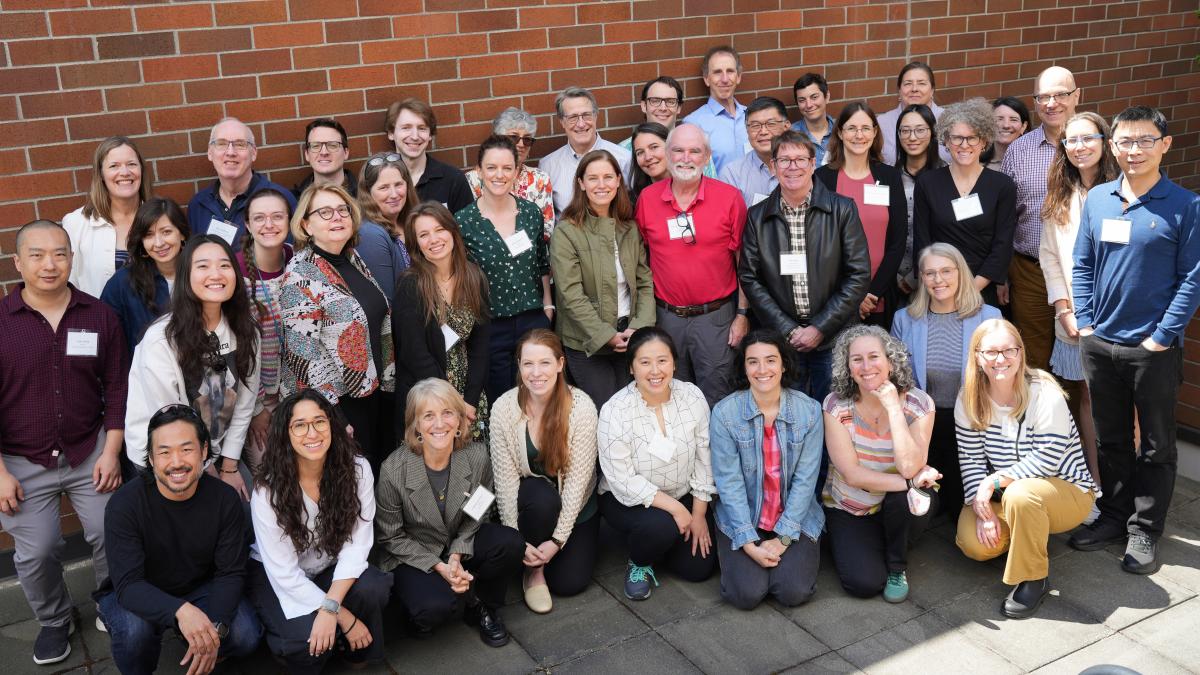
Once a year the University of Washington (UW) Interdisciplinary Center for Exposures, Diseases, Genomics & Environment (EDGE) hosts a symposium to bring together supporters from across UW and beyond to showcase the work of EDGE members and acknowledge outstanding contributions. This year the EDGE symposium was held on June 10th and focused on celebrating the success of the EDGE pilot program.
The event opened with EDGE Director Joel Kaufman announcing the National Institute of Environmental Health Sciences (NIEHS)’s renewal of the EDGE Center for the next five years—from June 1, 2026 to March 31, 2027, taking EDGE into its 31st year and beyond.
Kaufman described a new translational research framework for the center which emphasizes advancement from discovery to health implications to policy, and practice to outcome evaluation. The center also has a new Data Sciences Core to integrate the work of EDGE members and to complement the pre-existing Community Engagement Core and Translational Research Support Core.
Next Kaufman introduced Sheela Sathyanarayana, who leads EDGE’s Pilot Projects Program, one of the center’s most important functions. For thirty years, EDGE has been granting pilot awards to researchers who are undertaking innovative new directions in environmental health research. Applications are invited from across UW, the Fred Hutch Cancer Center and Seattle Children’s Hospital, often sparking interdisciplinary collaborations. For the past five years, EDGE has awarded between three and six pilot grants per year. For the next cycle (2026-2031), EDGE plans to fund four to five per year. Each funded project gets up to $40,000 in direct costs with an additional $10,000 available to projects featuring community engagement. In the last two EDGE grant cycles 33 pilot projects were awarded, leading to 58 publications and 15 grants totaling $22.7 million in funding (not including the 2025 pilots).

Recruitment for the next cohort of EDGE pilot projects will begin in September with pre-applications due in late 2026 and full applications due in early 2027. Sathyanarayana encourages early consultation for those interested in applying. Interested applicants can reach out to her (sheela.sathyanarayana@seattlechildrens.org) or to the EDGE Scientist Administrator Nancy Judd (njudd@uw.edu) for more information.
Next came a series of reports from recent EDGE pilot grant recipients. Katya Cherukumilli spoke about her work addressing lead in Washington State schools’ drinking water. Joan Casey and Marissa Childs presented their work using satellite-based machine learning estimates of freshwater harmful algal blooms and associations with dementia. Lisa Maves presented her work defining novel gene interactions that lead to embryonic heart defects in a zebra fish model. Samantha Lapehn and Alison Paquette spoke about their research exploring how endocrine-disrupting chemicals affect mRNA and miRNA signatures during pregnancy. Allison Sherris and Catherine Karr described their creation of a novel spatial model of insecticide exposure in Washington’s Yakima Valley. Finally, Yijie Geng talked about his work to develop a first-of-its-kind platform for assessing whole-body epigenetic toxicity of environmental contaminants in a zebra fish at a single cell resolution.
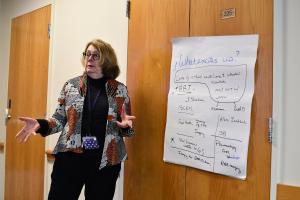
Presentations on recent pilot projects were followed by breakout group discussions of the Collaborative Translational Research Teams. Topics mirrored the team themes and were “microbiome and chronic disease,” “exposomics and precision environmental health,” “toxico-epigenetics and the developmental origins of health and diseases,” “air pollution and environmental epidemiology” and “building resilient communities.”
After a networking lunch came a series of presentations on five pilot project successes. Ashleigh Theberge spoke about an innovation she developed that allows for decentralized longitudinal transcriptomic studies using mRNA. Libin Xu talked about the impact of quaternary ammonium compounds (chemicals commonly found in household disinfectants) on the gut microbiome and gut-liver interactions. Trang VoPham presented her work taking an epidemiological approach to investigate the effect of solar jetlag on liver cancer. Catherine Karr and Sarah Benki-Nugent spoke about their research examining the effects of early life exposures to air pollutants from indoor cooking fuel on child development in urban Kenya. Finally, Edmund Seto presented his work conducting and interpreting results of mobile monitoring of air pollution.
To round out the symposium Kaufman presented a series of awards to EDGE researchers who have distinguished themselves through important contributions to science. These were as follows:
Most Impactful Research Award: Joan Casey and Marissa Childs
De Novo EDGE Core Creator Award: Edmund Seto
Public Engagement Award: Anjum Hajat
EDGE Enduring Impact Award: Theo Bammler
Impact on New Approach Methodology Award: Brad Hansen
Early Career Enhancement Investigator: Yijie Geng
After the presentation of awards, attendees relocated to the patio for an outdoor reception with cake and refreshments.