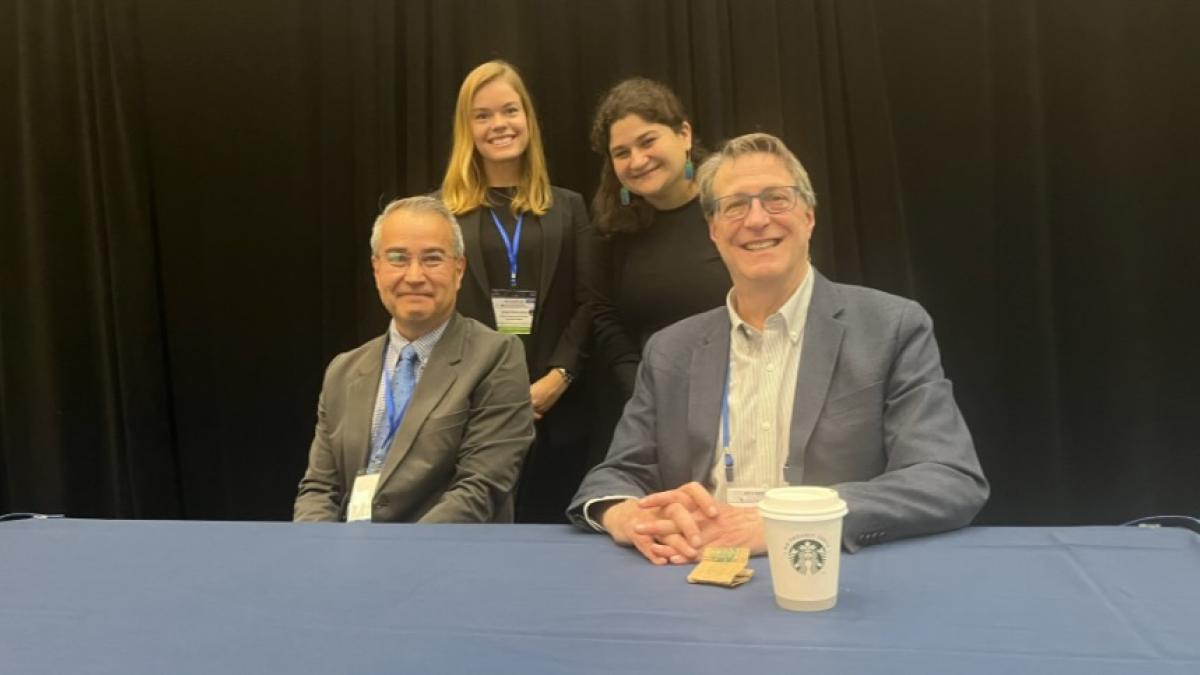
Four members of the University of Washington (UW) Interdisciplinary Center for Exposures, Diseases, Genomics and Environment (EDGE) and one EDGE community partner traveled to Lexington, Kentucky last month to attend the 2025 annual meeting of the National Institute of Environmental Health Sciences (NIEHS) Environmental Health Sciences Core Centers. In attendance were Joel Kaufman, EDGE Director; Christine Loftus, EDGE member and pilot grant recipient; Anjum Hajat, EDGE member; Joseph Santana, Environmental Health Equity Manager for the Duwamish Valley Community Coalition, an EDGE partner organization; and Lisa Hayward, Manager of the EDGE Community Engagement Core.
Loftus presented her work about how parents protect their children from the harmful effects of wildfire smoke and what barriers might exist to additional protective behaviors. To study this, she and her colleagues are developing, piloting and evaluating a protocol to collect time-sensitive data following wildfire smoke events using the national Environmental Influences on Child Health Outcomes (ECHO) Cohort. Her team has developed surveys in Spanish and English to collect data on health symptoms, health care utilization, protective steps taken to avoid smoke exposure, and barriers to action. These are to be administered within days of acute smoke exposure. If successful, the protocol can be scaled up for implementation across the nationwide ECHO cohort and results can be used to inform future public health interventions. Catherine Karr, who directs EDGE's Integrative Environmental Health Sciences Facility Core, was a co-author.
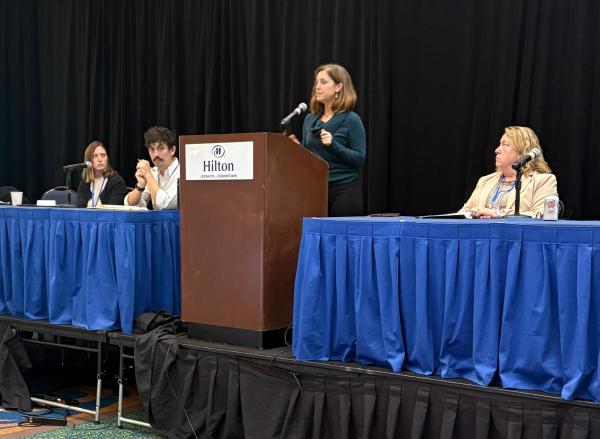
Hajat and Santana presented on their research project known as DAISY, or The Duwamish Air Improvement Study for Youth, as part of a plenary panel titled “Research Responsive to Community-Identified Priorities: Community-Academic Science Partnerships.” The goal of DAISY is to help improve the quality of life for asthmatic children who live in the Seattle neighborhoods of South Park and Georgetown. Hajat and her co-principal investigator, Paulina Lopez, the Executive Director of the Duwamish River Community Coalition, lead the five-year grant from NIEHS which uses a local community-based air quality monitoring network to measure pollutants from road traffic and provides low-cost air cleaners to families with children with asthma in the Duwamish Valley of Seattle.
Hayward presented a poster titled “Seven accessible fact sheets synthesize the health effects of natural hazards for public health practitioners.” At the poster session she distributed fact sheets synthesizing information about the health effects of earthquakes, tsunamis, wildfire smoke, flooding, landslides, volcanoes, and the mental health impacts of all natural hazards, all written for public health practitioners tasked with emergency planning for natural hazards of highest risk in the Northwest.
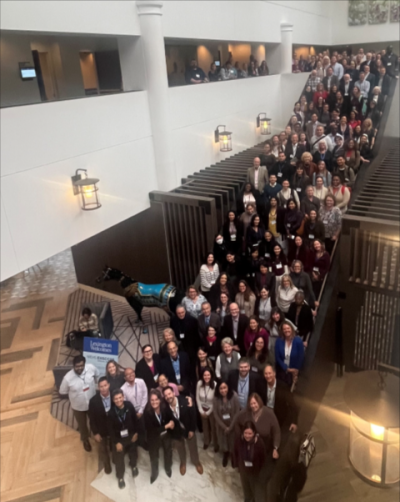
The event marked 25 years of community engagement being a required component of the NIEHS Environmental Health Sciences Core Centers. All participants attended sessions that wove together science and community engagement through panel presentations, plenary talks, posters, and networking opportunities, while also breaking out into sessions that were specific to science, administrative, or community engagement tracks.
The 2026 conference of the NIEHS Environmental Health Sciences Core Centers will be held in Rochester, New York and hosted by the University of Rochester.
- Career Development
- Pilot Projects Program
- Air Pollution