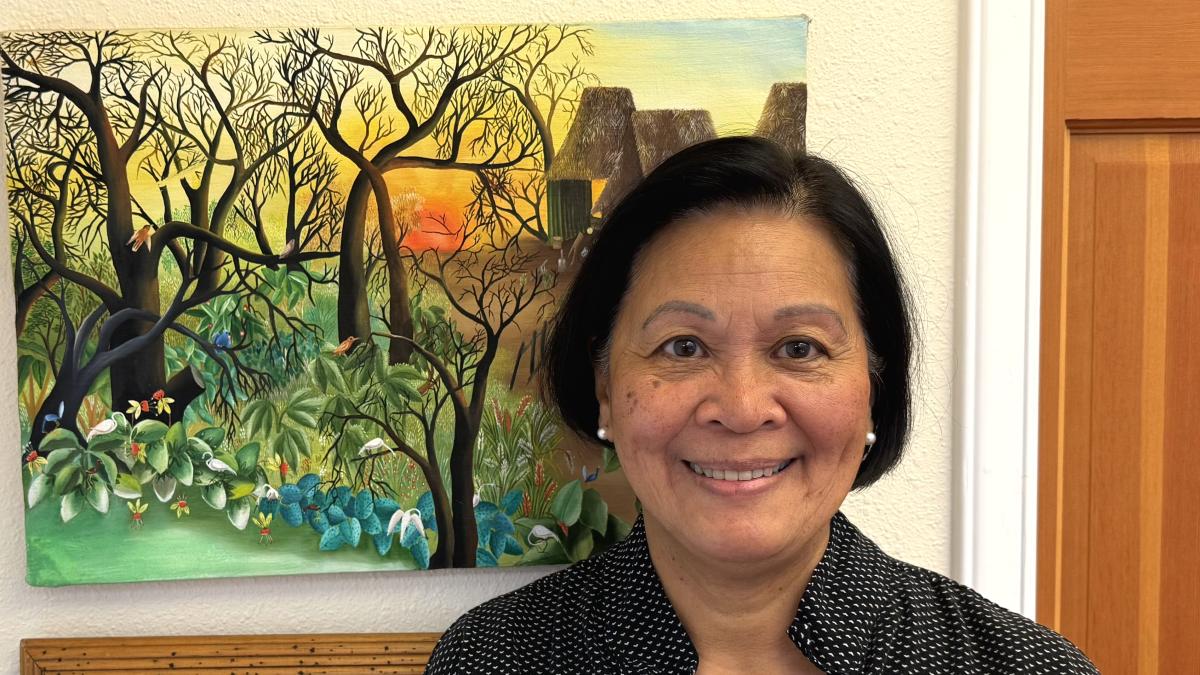
EDGE Community Advisory Board member, Maria Batayola, was still in high school when she fell in love with the Seattle community of Beacon Hill for its warmth and inclusiveness. “Once I spotted Beacon Hill, I knew I was going to move there as soon as I could,” she said. Her family had immigrated to Seattle from the Philippines when she was 14 and settled in the Central District. Once she graduated from college and had a job, she moved to Beacon Hill and lived there for more than 30 years, raising her son, and eventually becoming known unofficially as “the Mayor of Beacon Hill.”
Her community advocacy goes back just as far. When she was 16, she volunteered for the first Filipino Far West Youth Convention. “I heard Filipino American kids who were born here say they felt like they were not Filipino enough, they couldn’t speak the language–they were bullied. Out of that, I made a personal commitment to work in civil rights,” said Batayola. Since then, she’s worked on civil rights for over 33 years, retiring as a diversity manager from King County fifteen years ago to care for her ailing father.
Retirement did not slow Batayola’s advocacy work. She chaired the Governor’s Committee on Affirmative Action and worked with the Asian and Pacific Islander (API)’s Women’s Caucus, co-founding the Community Coalition for Environmental Justice, and the API Women and Family Safety Center to help victims of human trafficking, sexual assault, and domestic violence. She also helped lead El Centro De La Raza’s and Beacon Hill Council’s environmental, health, and climate justice work.
In 2015, Batayola lost her best friend and mentor, Ticiang Diangson, to lung cancer. Diangson, who lived in north Beacon Hill, had been partnering with a retired U.S. Environmental Protection Agency toxicologist to focus on air and noise pollution issues in the community, and, before she died, invited Batayola to join the effort. Their first move was to get Batayola on the Beacon Hill Council. “Beacon Hill is incredibly diverse,” said Batayola. “We couldn’t just focus on a singular issue, we had to take a look at all the issues impacting our beloved community.”
Prominent among those issues was environmental health, which Batayola has made a major focus. Specifically, she focuses on the effects of noise and air pollution caused by aircraft taking off and landing from the Seattle-Tacoma International and King County International Airports. “Here’s a big surprise,” Batayola said, “close to half a million people are impacted by aviation health impacts because these communities live near airports and under their flight paths.”
Through her work on aviation impacts Batayola was introduced to Timothy Larson, EDGE member and Professor Emeritus in the University of Washington (UW) Department of Civil and Environmental Engineering; Edmund Seto, Deputy Director of the EDGE Center and Professor in the UW Department of Environmental and Occupational Health Sciences (DEOHS); and Elena Austin, Associate Professor in DEOHS and co-director of the EDGE Exposure Assessment, Biomarkers & Environmental Sensors Facility Core.
Larson, Seto, and Austin have since worked with Batayola on numerous studies of the impacts of aviation in South Seattle. In one project known as the MOV-UP study, they collected samples from locations within a 10-mile radius of the Sea-Tac airport and analyzed them for ultra-fine particles associated with aircraft. Funded by the Washington State Legislature, the MOV-UP study was overseen by an external Study Advisory Board composed of fifteen community organizations, elected officials, and government agencies. The group, which includes Batayola, still meets to help guide future research into the health effects of aviation. It also inspired Batayola and El Centro De La Raza’s director Estela Ortega to obtain funding from the City of Seattle to conduct a similar study for Beacon Hill.
“My role is to advocate for Beacon Hill with my Council chair hat. Because I worked in government, I can navigate government and partner with public entities like EDGE,” said Batayola. “I’m always pleasantly surprised that we can work across differences.”
Seto and Austin are important partners to Batayola and the Beacon Hill Council. “I think I just carry Edmund and Elena in my mind all the time when I think about what rules to change and the data that will be needed,” said Batayola. Three things Batayola said she values about EDGE scientists are their openness, technical capacity, and their understanding of community.
Batayola represents the perspectives of the Beacon Hill Council not just on Seto and Austin’s projects but also for the EDGE Center overall, as a member of the Community Advisory Board, which meets regularly with the EDGE’s Community Engagement Core to set goals and priorities. In turn, EDGE is able to help Batayola identify university researchers to help Beacon Hill with projects that her community prioritizes. “You guys are able to say ‘in the university system, this is where they are and this is what they do.’ At the end of the day that helpfulness is really about resources we don’t have. I am so grateful to EDGE for sharing with us their science and technical skills. We [in the Beacon Hill Council] just don’t have that capacity,” said Batayola.
- Community Engagement
- Air Pollution